סריקה בתהליך...
הניתוח עשוי לארוך 30–90 שניות
הידעת?
הסרטון אינו מכיל תוכן רפואי
חושבים שחלה טעות?
אם לדעתכם הסרטון אכן עוסק בטענות רפואיות או בריאותיות, הוסיפו הסבר קצר ושלחו בקשה לבדיקה מחדש.
הבקשה התקבלה! נבדוק את הסרטון ונחזור אליכם.
אירעה שגיאה בשליחת הבקשה. נסו שוב.
דו״ח מאומת
הסרטון מציג מידע מדויק ומגובה במחקרים מדעיים אמינים.
סיכום
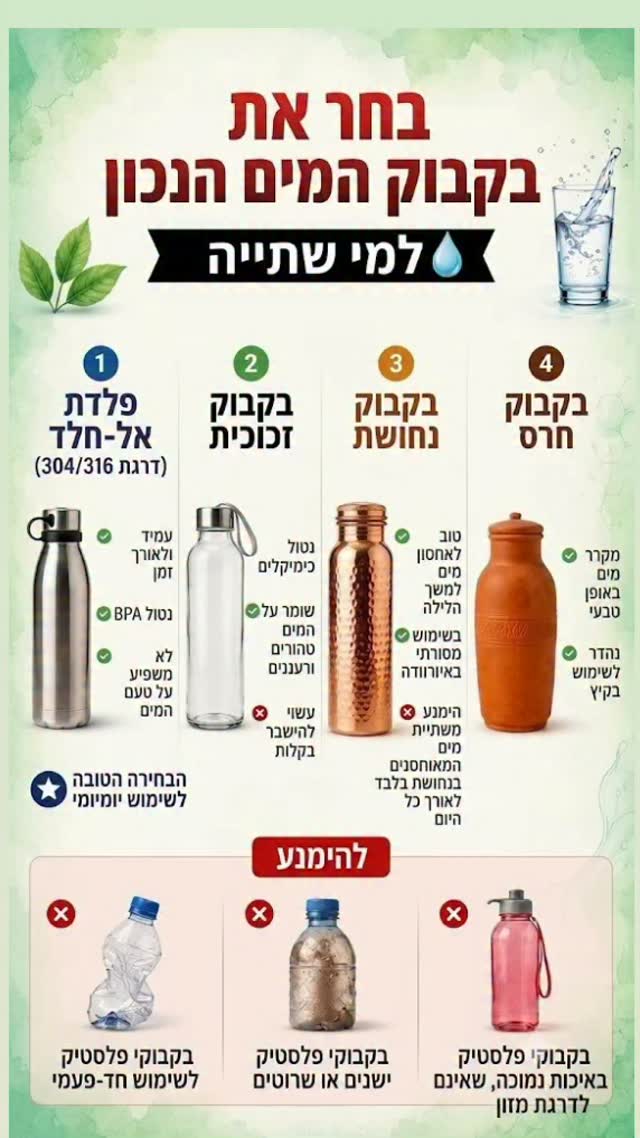
הטענות שנבדקו נתמכות ברובן על ידי הספרות המדעית. השימוש בפלדת אל-חלד ובזכוכית נחשב לבטוח ומומלץ בשל היותם חומרים אינרטיים. השימוש בנחושת לאחסון קצר מועד נמצא יעיל להפחתת חיידקים, אך דורש זהירות. השימוש בבקבוקי פלסטיק חד-פעמיים לשימוש חוזר הוכח כבעייתי בשל שחרור חומרים מזיקים ומיקרו-פלסטיק. לא נמצאו ראיות מדעיות ספציפיות ב-PubMed המאששות את הטענה לגבי קירור טבעי בבקבוקי חרס.
analytics ניתוח טענות מבוסס ראיות
"בקבוקי חרס מקררים את המים באופן טבעי ומתאימים לשימוש בקיץ."
מסקנת הבדיקה:
בעוד שקיימת מסורת תרבותית ארוכת שנים לשימוש בכדי חרס לקירור מים באמצעות אידוי, לא נמצאו ב-PubMed מחקרים מדעיים מודרניים המאמתים את יעילות הקירור או את בטיחות השימוש בהם בהשוואה לחלופות מודרניות. (⬜)
"בקבוקי פלדה אל-חלד (דרגת 304/316) הם הבחירה הטובה ביותר לשימוש יומיומי, שכן הם נטולי BPA ואינם משפיעים על טעם המים."
מסקנת הבדיקה:
פלדת אל-חלד (דרגות 304/316) נחשבת לחומר בטוח למגע עם מזון ושתייה, אינה מכילה BPA, ואינה מגיבה כימית עם מים באופן שמשנה את טעמם, מה שהופך אותה לבחירה מומלצת לשימוש יומיומי. (🟩)
"בקבוקי זכוכית שומרים על מים טהורים ורעננים וקלים לניקוי."
מסקנת הבדיקה:
זכוכית היא חומר אינרטי שאינו מגיב עם מים, אינו משחרר כימיקלים, וקל לניקוי וחיטוי, מה שמסייע בשמירה על איכות המים וטוהרם. (🟩)
chevron_right מקורות מדעיים: (2)
-
link
Diversity, Physiochemical and Phylogenetic Analyses of Bacteria Isolated from Various Drinking Water Sources.
To evaluate the indigenous bacterial strains of drinking water from the most commercial water types including bottled and filtered water that are currently used in Saudi Arabia. Thirty randomly selected commercial brands of bottled water were purchased from Saudi local markets. Moreover, samples from tap water and filtered water were collected in sterilized glass bottles and stored at 4°C. Biochemical analyses including pH, temperature, lactose fermentation test (LAC), indole test (IND), methyl red test (MR), Voges-Proskauer test (VP), urease test (URE), catalase test (CAT), aerobic and anaerobic test (Ae/An) were measured. Molecular identification and comparative sequence analyses were done by full length 16S rRNA gene sequences using gene bank databases and phylogenetic trees were constructed to see the closely related similarity index between bacterial strains. Among 30 water samples tested, 18 were found positive for bacterial growth. Molecular identification of four selected bacterial strains indicated the alarming presence of pathogenic bacteria The lack of awareness about good sanitation, poor personal hygienic practices and failure of safe water management and supply are the important factors for poor drinking water quality in these sources, need to be addressed.…
PMID: 28811799
-
link
The importance of hygienic practices during the collection and bottling of mineral water.
Natural water suitable for direct bottling must be clear, colourless, and free from objectionable taste and odour. The mineral content must be limited in amount, otherwise the water would come within the medicinal water category. There should be no detectable organic matter present and the water must be of the highest bacteriological quality -- virtually sterile - and should remain in this condition during the collection and bottling processes. In order to achieve and maintain this high quality, the gathering grounds of the source must be protected from pollution; the construction of the well or spring must be such as to prevent external contamination, as also should be the collecting and bottling apparatus. Personnel employed in the factory should wear protective clothing and be regularly checked as to their freedom from waterborne infectious diseases. Control of the water as to its hygienic quality should be by regular and frequent analysis of samples of the water and the air at various points in the process and in the factory. A new problem that has arisen and has to be faced in this situation is the risk of contamination by certain materials in contact with the water that may contain substances that encourage the growth of saprophytic bacteria which would contaminate by the production of taste, odour, discolouration, cloudiness and definite evidence of microbial growth. It is emphasized that the extent of this new problem is not yet delineated and that methods of laboratory control and safeguards against such happenings are still evolving.…
PMID: 1027338
"בקבוקי נחושת מתאימים לאחסון מים למשך הלילה (לפי המסורת האיורוודית), אך יש להימנע מאחסון מים בהם לאורך זמן."
מסקנת הבדיקה:
מחקרים מראים כי אחסון מים בכלי נחושת לזמן קצר (כמו לילה) יכול להפחית עומס חיידקי, אך אחסון ממושך עלול להוביל לריכוזי נחושת גבוהים מהמומלץ, ולכן יש להימנע מכך. (🟩)
"שימוש בבקבוקי פלסטיק ישנים, שרוטים או חד-פעמיים עלול להוביל להפרשת חומרים מזיקים למים."
מסקנת הבדיקה:
ספרות מדעית ענפה מאשרת כי שימוש חוזר בבקבוקי פלסטיק חד-פעמיים, במיוחד כאשר הם שרוטים או חשופים לחום, עלול להגביר את שחרור המיקרו-פלסטיק וחומרים כימיים (כמו אנטימון או פתלאטים) לתוך המים. (🟩)
chevron_right מקורות מדעיים: (3)
-
link
Adverse health effects of exposure to plastic, microplastics and their additives: environmental, legal and policy implications for Israel.
Israel is a regional "hotspot" of plastic pollution, with little discussion of potential adverse health effects from exposure to plastic. This review aims to stimulate discussion and drive policy by focusing on these adverse health effects. Plastics are synthetic polymers containing additives which can leach from food- and beverage-contact plastic into our food and beverages, and from plastic textiles onto our skin. Plastics persist in the environment for generations, fragmenting into MNPs: Micro (1 micron-5 mm)-Nano (1 nm-1 micron)-Plastic, which contaminate our atmosphere, water, and food chain. MNP can enter the human body through ingestion, inhalation and touch. MNP < 10 microns can cross epithelial barriers in the respiratory and gastrointestinal systems, and fragments < 100 nm can cross intact skin, enabling entry into body tissues. MNP have been found in multiple organs of the human body. Patients with MNP in atheromas of carotid arteries have increased risk of a combined measure of stroke, cardiovascular disease, and death. Toxic additives to plastics include bisphenols, phthalates, and PFAS, endocrine-disrupting chemicals (EDCs) which cause dysregulation of thyroid function, reproduction, and metabolism, including increased risk of obesity, diabetes, endometriosis, cancer, and decreased fertility, sperm count and quality. Fetal exposure to EDCs is associated with increased rates of miscarriages, prematurity and low birth weight. There is likely no safe level of exposure to EDCs, with increasing evidence of trans-generational and epigenetic effects. There are several existing Israeli laws to reduce plastic use and waste. Taxes on single-use plastic (SUP) were recently cancelled. There are many gaps in regulatory standards for food-, beverage- and child- safe plastic. Existing standards are poorly enforced. Reduction in production and use of plastic, promotion of recycling and reduction of leaching of toxic additives into our food and beverages are essential policy goals. Specific recommendations: Periodic monitoring of MNP in bottled beverages, food, indoor air; Strengthen enforcement of standards for food-, beverage-, and child-safe plastic; Renew tax on SUPs; National ban on SUP at public beaches, nature reserves and parks; Ban products manufactured with MNP; Increase research on sources and health outcomes of exposure to MNP and EDCs.…
PMID: 39256853
-
link
Association of drinking-water source and use characteristics with urinary antimony concentrations.
Environmental factors, such as storage time, frequency of bottle reuse and temperature, have been shown to facilitate antimony (Sb) leaching from water- and food-packaging materials. The globally escalating consumption of water packaged in Sb-containing bottles, such as that of polyethylene terephthalate (PET), could increase human daily Sb doses. This study set out to investigate the relationship between drinking-water source, use characteristics, and urinary Sb concentrations (U-Sb) accompanied with survey responses of a healthy (n=35) Cypriot participant pool. One spot urine sample was collected during administration of questionnaire, while a second spot urine sample was collected from the same individual about 7 days later. Urinary and water Sb concentrations were measured with an inductively coupled plasma mass spectrometer. Survey responses showed that bottled water summed over various volumes and plastic types, such as polycarbonate and PET contributed to an average 61% of daily water consumption. Water sources such as tap, mobile stations (explained in a following section), and well water contributed to 24%, 14%, and 2% of an individual's daily water consumption pattern, respectively. Average daily potable water use of both bottled and tap water by individuals consisted of 65% drinking-water, while the remaining 35% was water used for preparing cold and hot beverages, such as, tea, coffee, and juices. A significant (P=0.02) association between per capita water consumption from PET bottles and urinary creatinine-unadjusted concentrations was observed, but this relationship did not remain after inclusion of covariates in a multivariate regression model. In the creatinine-adjusted regression model, only gender (female) was a significant (P<0.01) predictor of U-Sb, after adjusting for several covariates. It is proposed that consumption data collection on various water uses and sources among individuals could perhaps decrease the uncertainty associated with derivations of acceptable daily Sb intakes.…
PMID: 23188481
-
link
Phthalates residues in plastic bottled waters.
This study was conducted to determine the presence of phthalates in 10 different brands of bottled water available in Saudi markets and stored under different conditions. Dimethyl phthalate (DMP), diethylphthalate (DEP), di-n-butyl phthalate (DBP), benzyl butyl phthalate (BBP) and diethyl hexyl phthalate (DEHP) were measured by headspace solid-phase microextraction followed by gas chromatography- mass spectrometer detector. Most of these phthalates were detected in the selected bottled water sample that might be either leached from the plastic packaging materials or contamination during bottling processes. Bottled waters stored at 4°C contained higher levels of DMP, DEP, BBP and DEHP than those stored at room temperature and outdoors. On the other hand, the levels of DMP, DEP and BBP were significantly lower in bottled waters stored at room temperature than those outdoor. It seems that temperature and sunlight play a role in the degradation of phthalates within time. The levels of BBP were the highest at 4°C storage (4.592 ± 3.081 µg/l; range: 1.194-21.128 µg/l) and approximately 76% of the bottled waters had BBP above the limit of quantification (LOQ) of 0.994 µg/l. Apart from DEHP (< 6 µg/l), there are not current legislations for other phthalates. Regardless of storage conditions, all our samples did not exceed the maximum established limit of DEHP. Although, the levels of phthalates in tested bottled waters were low, one should not dismiss that these chemicals may cause endocrine disruption through several mechanisms, especially to potentially vulnerable populations such as infants and pregnant women. Saudi Arabia ranks 12 in bottled water consumption (88 L per capita in 2004) among the 71 reported countries. With this high consumption, a quality assurance scheme for residue monitoring in water is quite important. Although, one cannot avoid phthalates contamination in bottled waters due to manufacturing process but at least special care should be taken regarding their storage conditions.…
PMID: 21804311

קוד_הבריאות
דירוג זה מבוסס על 2 דוחות אימות קודמים.
האם הדוח הזה היה מועיל לך?
מה היה פחות טוב? (רשות)
תודה על הפידבק!
עירעור על דוח זה
ספקו ראיות חדשות או הצביעו על אי דיוקים
נעדכן אותך על תוצאות הבדיקה
הוסיפו קישורים למחקרים או מקורות רפואיים מוכרים
העירעור נשלח בהצלחה!
המנוע המדעי שלנו יבדוק את הראיות שהגשתם. נעדכן אתכם באימייל עם התוצאות.
ניתוח מבוסס בינה מלאכותית
דוח זה נוצר באופן אוטומטי על ידי מערכת בינה מלאכותית ועשוי להכיל שגיאות, אי-דיוקים או מידע חלקי. הניתוח אינו מהווה ייעוץ רפואי, אבחנה או המלצה לטיפול, והוא אינו תחליף לדעתו של איש מקצוע רפואי מוסמך. יש להתייעץ עם רופא או מומחה מוסמך לפני קבלת כל החלטה רפואית. המידע מוצג לצרכי מידע כללי בלבד.
מידע זה מופק על ידי בינה מלאכותית ואינו מהווה תחליף לייעוץ רפואי מקצועי.